In 2026, Chief Financial Officers (CFOs) are navigating a rapidly evolving business landscape shaped by digital transformation, economic uncertainty, and the accelerating adoption of AI and automation. As one CFO community member shared, “We have to strike the right balance between the advancement of AI technology, focusing on the talent pool, having a collaborative mindset, creative thinking, and problem-solving – and these are all shifting.”
To better understand the top priorities, challenges, and opportunities facing finance leaders this year, we surveyed more than 100 CFOs from across industries. Their insights, combined with in-depth discussions with CFOs, provide a comprehensive view of the evolving role of the CFO.
In this report, we dive deeper into the survey results, highlighting the key themes and strategic imperatives shaping the future of finance leadership.
Top Functional Priorities for CFOs
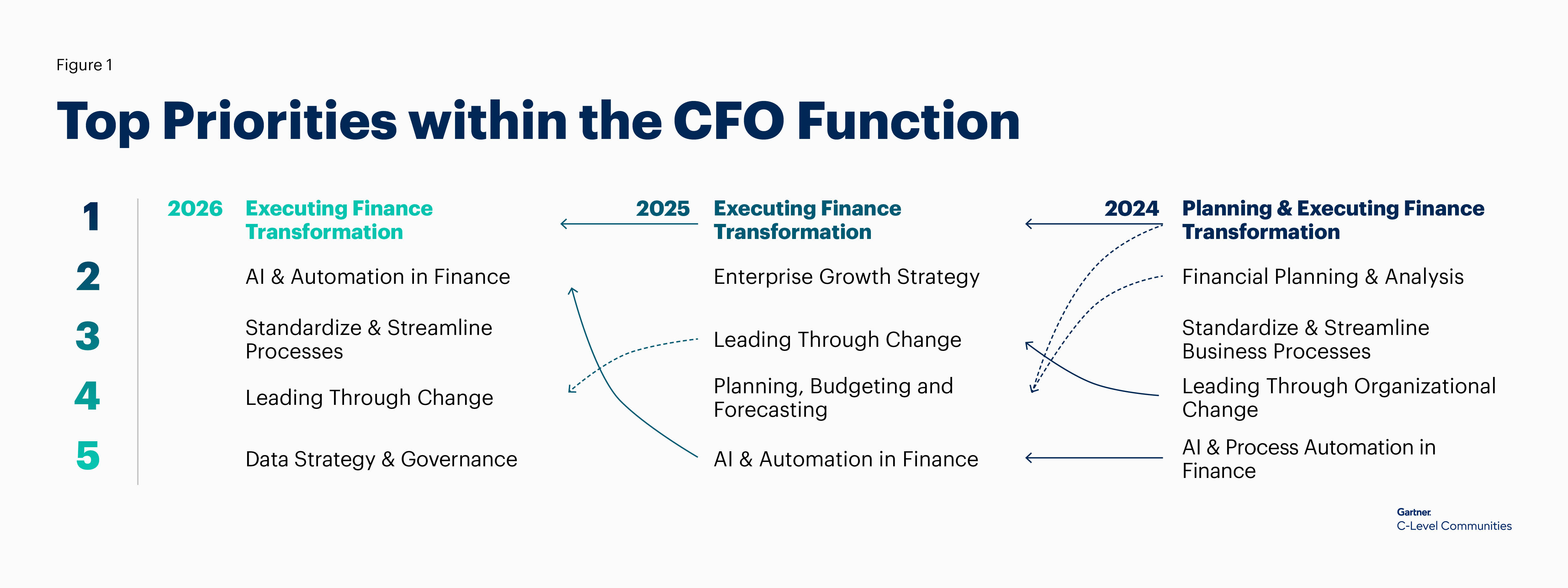
This year’s survey reveals a notable shift in CFO priorities as they adapt to a rapidly changing financial landscape:
- Executing Finance Transformation remains the leading focus, reflecting ongoing efforts to modernize finance operations and align them with broader organizational goals.
- AI & Automation in Finance has surged to the second spot, rising from fourth place last year, highlighting the growing importance of technology-driven solutions for efficiency and innovation.
- Standardize & Streamline Processes reenters the top five, now ranking third after being absent in 2025, signaling renewed attention to operational consistency and process improvement.
- Leading Through Change moves down one position to fourth, underscoring the continued importance of effective change management.
- Data Strategy & Governance makes its debut in the top five, reflecting an expanding emphasis on data-driven decision-making and robust governance frameworks.
Notably, Enterprise Growth Strategy and Planning, Budgeting & Forecasting have dropped significantly in priority this year, indicating a shift toward transformation, automation, and data-centric approaches.

Executing Finance Transformation: Addressing Urgency and Complexity
“Executing Finance Transformation” remains the top priority for CFOs, but the path to success is complex. According to Gartner insights, only 13.5% of finance leaders report a clearly successful transformation, while more than 70% say their initiatives are moving slower or delivering less impact than expected.
In follow-up conversations with CFO community members, the realities behind these numbers came into focus. As one CFO shared, “Balancing a large transformation program with day-to-day operations is a constant challenge. Teams are often so laser focused on cost cutting, it’s important to step back and think about how the finance function can deliver more value.”
Capacity constraints are a major barrier, with 61% of CFO survey respondents citing competing priorities as their most significant challenge. Many finance leaders are responding by investing in talent transformation, including upskilling existing teams, attracting tech-savvy professionals, and building centers of excellence to centralize and automate core processes. One CFO explained, “We’ve established a group similar to a mini Chief Data & Analytics Office, bringing together various streams to move the finance team forward and bring down costs.”
Transformation often involves rethinking team structures, integrating new technology, and standardizing processes across both local and global operations. As another CFO noted, “We are in year 2 of a 3-year finance function transformation. Our focus is on process improvement, enhancing data and analytics capabilities, and supporting our team in upskilling for the future.”
Despite the complexity, CFOs recognize that successful transformation requires more than a roadmap. Sustained change management, employee adoption, and a focus on business partnership are essential for delivering long-term value. The most effective finance leaders are aligning transformation efforts with day-to-day realities, ensuring the finance function is not just efficient, but a true driver of enterprise growth and innovation.
To better understand where CFOs are focusing their efforts – and what stands in their way – our survey asked finance leaders to identify their primary goals and biggest challenges in executing finance transformation. The results provide a clear snapshot of what’s top of mind for CFOs as they navigate this complex journey:
Goals for Executing Finance Transformation
71% Improving processes and efficiencies
68% Making data-driven decisions
63% Developing talent and skills
Challenges around Executing Finance Transformation
61% Competing priorities
51% Company Culture
41% Lack of skills
AI & Automation in Finance: Navigating Promise and Performance
AI and automation have rapidly climbed the CFO agenda, now standing as the second-highest priority for finance leaders in 2026. Yet, the journey from experimentation to tangible ROI remains challenging. According to Gartner insights, 84% of CFOs say they have not yet realized a return on their AI investments in finance, underscoring the need for clear roadmaps, credible use cases, and robust controls.
AI and automation are reshaping finance teams, workflows, and the skills required for success. By 2030, Gartner predicts that 90% of finance team members will be “digital talent” skilled in both finance and technology. CFOs are responding by elevating AI leadership, forming cross-functional committees, and investing in upskilling to ensure their teams are future-ready.
However, the path forward is not without obstacles. Many CFOs cite legacy technology, lack of skills, and employee adoption as persistent barriers. One CFO noted, “Rolling out AI and automation is challenged by competing priorities and the costs involved. We’re still scratching the surface, and governance remains a challenge.”
As finance leaders accelerate AI and automation initiatives, their ambitions and concerns are reflected in the following survey findings:
Goals for AI & Automation
92% Improving processes and efficiencies
67% Making data-driven decisions
51% Increasing velocity and speed delivery
Challenges around AI & Automation
64% Lack of skills
46% Legacy technology
44% Employee Adoption
Standardize & Streamline Processes: Building the Foundation for Finance Transformation
Standardization and process improvement are at the heart of finance transformation for CFOs in 2026. The push to streamline workflows and eliminate manual tasks is not just about efficiency – it’s about preparing finance teams for the next wave of automation and AI. As Gartner warns, “Avoid automating broken processes that involve plugging automation tools into inferior processes that extend the life of legacy issues and result in short-term fixes that require expensive rework later.”
CFOs are making tough decisions regarding whether to automate, outsource, or redesign processes entirely. As one CFO noted, “There are so many manual processes we’re doing that can be improved. It’s hard to decide what to prioritize.”
CFOs are also rethinking not just how processes are executed, but what capabilities should be prioritized to unlock innovative ways of working. “Cross collaboration at the senior level is essential for having a unified view and sense of strategy and execution,” shared one CFO. Another mentioned how alignment across teams and functions is a “requirement for driving business outcomes without friction.”
Looking ahead, reporting automation, business process automation (BPA), and workflow automation deliver the highest ROI according to Gartner insights. CFOs estimate that by 2030, up to 80% of finance work will be automated or AI-augmented. The challenge is aligning competing priorities, overcoming skill gaps, and shifting company culture to embrace standardized ways of working.
Goals for Standardize and Streamline Processes
86% Improving processes and efficiencies
57% Increasing velocity and speed delivery
46% Improving business outcomes
Challenges around Standardize and Streamline Processes
51% Competing Priorities
43% Lack of skills
41% Company culture
CFOs’ Priorities Across the Enterprise
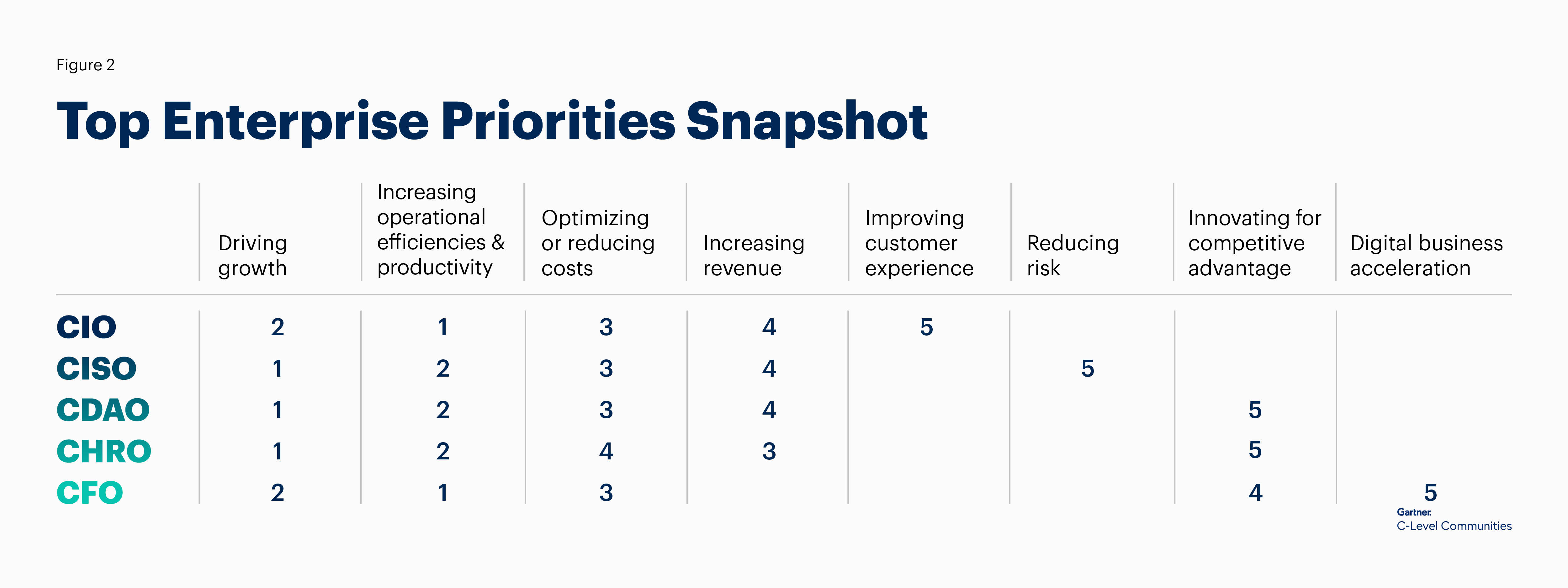
Beyond their core finance responsibilities, CFOs are shaping and responding to broader organizational imperatives identified in this year’s Leadership Perspective Survey. The 2026 results show that CFOs’ top enterprise priorities are closely aligned with those of other C-suite leaders, reflecting a unified executive focus across the organization.
This year, increasing operational efficiency and productivity has emerged as the leading enterprise-wide priority for CFOs, narrowly surpassing driving growth. Optimizing or reducing costs remains a central focus, rounding out the top three – an emphasis shared by their CIO counterparts. Notably, innovating for competitive advantage and digital business acceleration have entered the top five for the first time, highlighting a growing commitment to transformation and future-readiness.
In contrast, priorities such as increasing revenue and improving customer experience, which were prominent in 2025, have dropped off the list this year. This shift underscores the CFO’s evolving role in supporting enterprise agility, efficiency, and innovation in a dynamic business environment.
The table below offers a comparative snapshot of the top enterprise priorities for CFOs and their C-level peers in 2026.
The Outlook for CFOs
As organizations navigate a landscape shaped by economic volatility, technological advancement, and evolving business models, the role of the CFO is more strategic – and more complex – than ever. The survey results highlight how CFOs are advancing as enterprise leaders, driving operational efficiency, productivity, and transformation while balancing costs and innovation.
Looking ahead, CFOs will continue to lead finance transformation, investing in talent, technology, and process redesign to ensure their teams are equipped for the future. AI adoption and automation is set to accelerate, promising greater efficiency and new opportunities for data-driven decision making. However, realizing the full value of these investments will require careful governance, clear use cases, and a commitment to upskilling the finance workforce.
Standardization and streamlining of processes will remain a cornerstone, enabling CFOs to unlock measurable gains and prepare for the next wave of automation. As finance teams become more digitally enabled, CFOs must foster a culture of continuous improvement, collaboration, and adaptability.
Across the enterprise, CFOs are aligning closely with their C-suite peers on priorities such as operational excellence, cost management, and innovation. Their ability to anticipate trends, respond to disruption, and lead with vision and agility will be critical to organizational success in the years ahead.
CFOs across Gartner CFO Communities regularly connect with local peers to discuss critical priorities, share expertise, and learn from one another. To participate in a Gartner CFO Community, apply to join, or if you are already a member, sign in to learn more and register for your upcoming community events.
Based on 115 CFO responses from Gartner C-level Communities’ proprietary Leadership Perspective Survey, July 2026.
By CFOs, For CFOs®
Find your local community and explore the benefits of becoming a member.